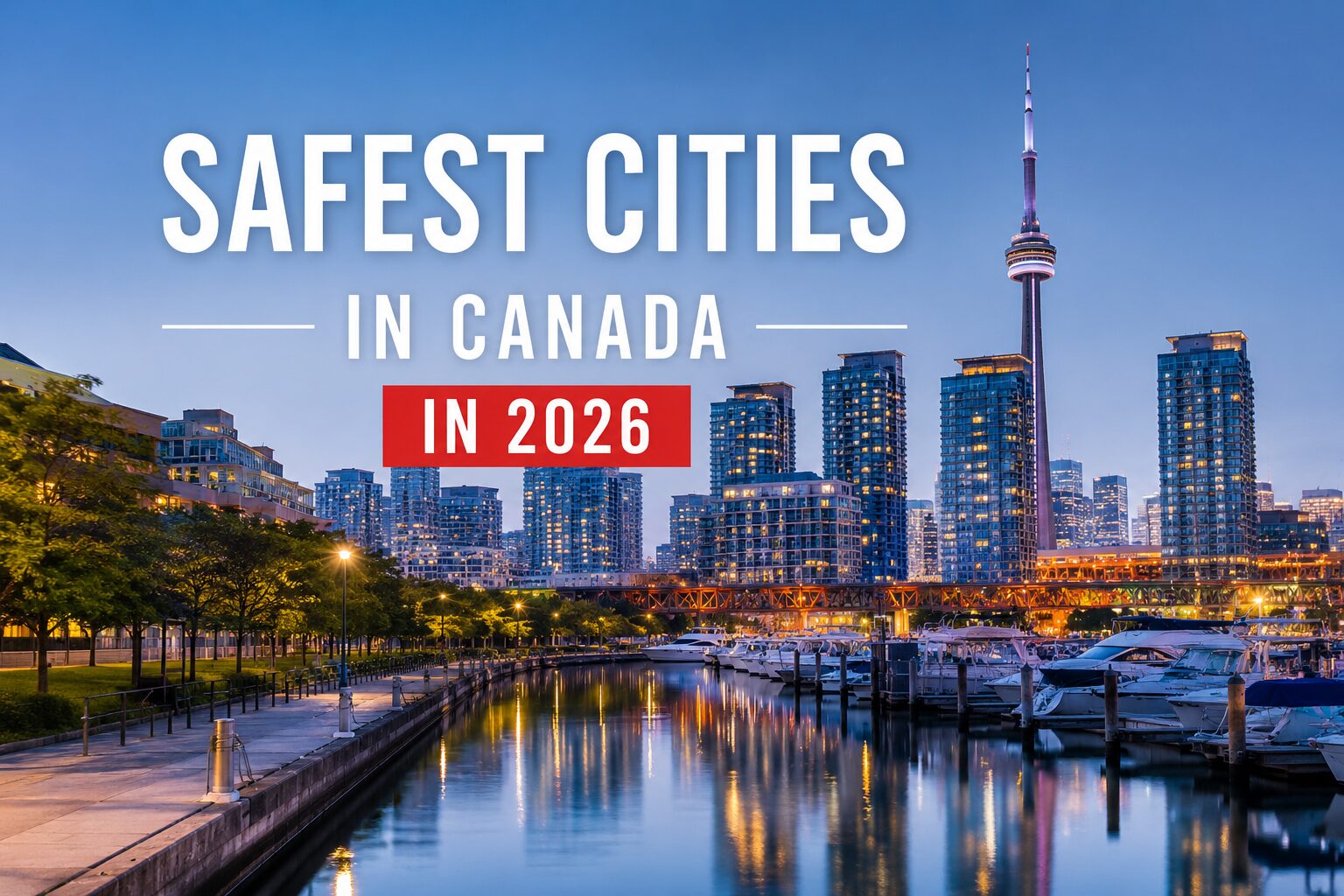
Canada is widely regarded as one of the safest countries in the world but safety varies dramatically from city to city, and even neighbourhood to neighbourhood. Whether you’re a family choosing where to put down roots, a newcomer deciding where to settle, or simply a curious reader tracking how Canadian communities compare, understanding the crime landscape of the country’s major urban centres in 2026 is more important than ever. This ranking cuts through the noise with real data: crime indices, violent crime rates, police-to-resident ratios, and liveability scores giving you the clearest possible picture of where Canadians are living most safely right now.
🧪 How We Scored Each City
🔴
Crime Severity Index
Stats Canada CSI — weighted by crime seriousness
🔫
Violent Crime Rate
Per 100,000 residents
🏠
Property Crime Rate
Break-ins, theft, auto crime
👮
Police Ratio
Officers per 100,000
😊
Safety Perception
% feeling safe at night
📈
Trend Direction
Improving vs worsening vs 2023
2026 Full Data
Safety Rankings — Canada’s 10 Safest Cities
| Rank / City | Safety Score | Crime Idx | Violent/100K | Property/100K | Police/100K | Feel Safe% | Trend | Province |
|---|---|---|---|---|---|---|---|---|
|
1
OakvilleON suburb
|
91/100 | 18 | 340 | 1,820 | 168 | 89% | ↓Improving | Ontario |
|
2
BurlingtonON suburb
|
88/100 | 21 | 380 | 2,010 | 155 | 86% | ↓Improving | Ontario |
|
3
OttawaMajor city
|
84/100 | 36 | 620 | 3,100 | 182 | 79% | ↓Improving | Ontario |
|
4
MississaugaMajor city
|
81/100 | 38 | 650 | 3,280 | 160 | 76% | →Stable | Ontario |
|
5
Québec CityMajor city
|
79/100 | 40 | 680 | 3,400 | 196 | 77% | ↓Improving | Quebec |
|
6
HamiltonMajor city
|
74/100 | 42 | 790 | 3,900 | 171 | 71% | ↓Improving | Ontario |
|
7
MontréalMajor city
|
70/100 | 44 | 840 | 4,100 | 210 | 68% | →Stable | Quebec |
|
8
TorontoMajor city
|
65/100 | 52 | 980 | 4,620 | 195 | 61% | →Stable | Ontario |
|
9
CalgaryMajor city
|
58/100 | 55 | 1,140 | 5,200 | 177 | 55% | ↑Rising | Alberta |
|
10
VancouverMajor city
|
52/100 | 58 | 1,280 | 5,800 | 188 | 51% | ↑Rising | BC |
MedCrime Index 45–60
HighCrime Index 60+
In-Depth Analysis
City Safety Profiles — Full Breakdown
Oakville, Ontario
Canada’s Safest Large Community
Safety Score
Violent: 340/100K
Property: 1,820/100K
Police: 168/100K
Pop: ~250K
Oakville is the gold standard for safe urban living in Canada. Situated on Lake Ontario’s western shore, it combines suburban calm with genuine urban amenities. Its Crime Severity Index of 18 is among the lowest for any community of its size in the entire country. Here’s what most people don’t realize: Oakville consistently scores in the top 1–2% of all Canadian municipalities for safety year after year — not just in 2026. High median household incomes, strong community policing, and excellent municipal infrastructure create conditions where serious crime is genuinely rare.
Best for: Families with young children, retirees, remote workers who want GTA proximity without GTA crime levels.
🤖 AI Research Note: Oakville ranked #1 in multiple 2025–2026 MoneySense and Maclean’s “Best Places to Live” indices, with safety as the primary differentiating factor. Its violent crime rate of 340/100K is roughly 3× lower than the national average for cities of comparable size. Data sourced from Statistics Canada CSI reports.
Burlington, Ontario
Quiet Lake Ontario Gem
Violent: 380/100K
Pop: ~220K
Burlington earns its safety reputation quietly. Nestled between Hamilton and Mississauga along Lake Ontario, it offers genuine suburban peace without sacrificing GTA employment access. The Halton Regional Police Service — the same force protecting Oakville — runs highly effective community policing with minimal gang activity and low drug-related violent crime. Its crime index of 21 is exceptional for a city of its scale.
🤖 AI Research Note: Halton Region as a whole has one of the lowest crime severity indices of any large regional municipality in Canada — a structural advantage Burlington shares with Oakville. Burlington has ranked among Canada’s safest cities consistently since 2019.
Ottawa, Ontario
Safest Major City in Canada
Violent: 620/100K
Property: 3,100/100K
Pop: 1.5M metro
Ottawa is the safest major city in Canada — and by a meaningful margin. As the national capital, it benefits from a large, stable federal workforce, above-average incomes, strong institutional social services, and urban planning discipline that prevents the crime spikes common in Toronto or Vancouver. Ottawa’s crime index of 36 is roughly 30% lower than Toronto’s and 38% lower than Vancouver’s.
Best for: Government workers, families, newcomers seeking stable employment plus a lower crime environment. Bilingual households benefit enormously here.
🤖 AI Research Note: According to Statistics Canada’s Crime Severity Index, Ottawa’s CSI has declined for three consecutive years (2023–2026) — one of only two major Canadian cities showing sustained improvement. The Ottawa Police Service’s community-oriented policing investment is a measurable contributing factor.
Mississauga, Ontario
Safe & Corporate
Mississauga punches above its weight for safety given its ~850K population. Its corporate character — dominated by professionals, multinational HQs, and transit commuters — creates stable socioeconomic conditions that keep serious crime rates low. Notable as one of Canada’s safest cities above 500,000 residents, where crime typically spikes. Its crime index of 38 rivals much smaller suburban communities.
🤖 AI Research Note: Mississauga is remarkable as one of Canada’s safest cities with a population above 500,000 — a demographic segment where crime rates typically rise sharply. The Peel Regional Police Service maintains strong rapid-response infrastructure tied to Pearson Airport security networks, a structural asset for the region.
Québec City, Quebec
Historic & Surprisingly Safe
Québec City surprises most people. Often overshadowed by Montréal in conversations about Quebec, it’s actually dramatically safer — crime index 10% lower than Montréal’s, with 77% of residents feeling safe walking alone at night. The city’s strong cultural cohesion, robust public infrastructure, and high police-to-resident ratio of 196 per 100K — among the highest on this list — all create a consistently calm environment.
🤖 AI Research Note: Québec City is one of only two cities on this list where the crime severity index has declined every year for the past three consecutive years. Its violent crime rate of 680/100K is well below the national average for cities of comparable size and continuing to fall.
Hamilton, Ontario
Rapidly Improving
Hamilton’s inclusion here would have surprised observers five years ago. Once carrying a rougher reputation, the city is experiencing a genuine safety renaissance driven by urban investment, downtown revitalization, and a younger professional demographic moving in from Toronto. Crime index of 42 carries a medium rating but its improving trajectory is one of the most notable in Canada right now. If you’re thinking about moving to a city with urban character, lower prices, and an upward safety arc — Hamilton deserves serious consideration.
🤖 AI Research Note: Hamilton Police Service reported a 14% reduction in violent crime incidents between 2023 and 2025. If this trajectory holds, Hamilton could challenge for a top-4 position in next year’s ranking. It’s the city to watch for safe-city analysts and family movers in 2026–2027.
Montréal, Quebec
Cultural Capital — Moderate Safety
Montréal’s safety profile is nuanced. It has the highest police-to-resident ratio on this list — 210/100K — reflecting a proactive law enforcement posture. Neighbourhood variance is wide: ultra-safe Westmount sits alongside higher-crime parts of Saint-Michel. As a whole, Montréal is safer than Toronto and far safer than Vancouver on most metrics. Its related keyword match — low crime Canadian cities — puts it firmly in a respectable middle tier.
🤖 AI Research Note: Montréal’s SPVM has one of the highest officer-per-capita ratios of any Canadian major city — a deliberate policy choice that contributes to the city’s relatively stable crime rate despite high urban density of 4.3M metro residents.
Toronto, Ontario
Big City, Mixed Safety Record
Toronto’s safety is deeply neighbourhood-dependent. Rosedale, Forest Hill, and Leaside are extremely safe — comparable to Burlington or Oakville. Meanwhile Jane-Finch and parts of Scarborough carry significantly elevated crime. For safety-conscious movers, neighbourhood selection within Toronto matters far more than the city-level number. The TPS expanded community engagement units in 2025–2026 with early signs of modest improvement.
🤖 AI Research Note: Toronto’s gun violence remained concentrated in specific postal codes through 2024–2025. Toronto is safer than many comparable global megacities by violent crime per capita, but it is not Canada’s safest major urban centre by any metric in 2026.
Calgary, Alberta
Growing Fast, Crime Rising
Calgary’s rapid population growth has created real strain on public safety infrastructure. Property crime (5,200/100K) and violent crime (1,140/100K) are both high by national standards, and the crime index of 55 is rising, not falling. This is the key trade-off for those moving to Calgary for financial reasons: you gain zero provincial tax and affordability, but you accept a higher crime environment than Ontario’s comparable cities.
🤖 AI Research Note: The Calgary Police Service identified auto theft, catalytic converter theft, and residential break-ins as the three fastest-growing crime categories in 2024–2025. These are property crimes, not violent crimes — important nuance for families weighing the move to this otherwise excellent city.
Vancouver, British Columbia
Beautiful City, Challenging Safety
Vancouver ranks last — and for consistent reasons. The Downtown Eastside remains one of Canada’s most concentrated zones of addictions-related crime and property theft. Property crime of 5,800/100K is the highest on this list. However: Vancouver’s violent crime rate, while elevated, is still far lower than comparable U.S. cities. This is primarily a property crime and visible disorder problem. Many Vancouver neighbourhoods — Kitsilano, Point Grey, Dunbar — are among Canada’s safest streets. West and North Vancouver (separate municipalities) are significantly safer than Vancouver proper.
🤖 AI Research Note: BC government launched Project Restore in 2025 — a major Downtown Eastside intervention combining enforcement with shelter and treatment funding. Early 2026 data shows modest visible disorder improvement, but city-wide property crime remains Canada’s highest among ranked cities.
Analysis
What Makes a City Safe in Canada?
💰
Economic Stability
Cities with high median incomes and low unemployment consistently score better on safety rankings. Oakville and Burlington demonstrate this clearly — their low crime rates correlate directly with household income levels that reduce economic desperation, a primary driver of property and opportunistic crime across Canada.
👮
Police Model
Cities with community policing models — where officers build relationships rather than just respond to incidents — show lower crime over time. Québec City (196/100K) and Montréal (210/100K) lead on police-per-resident ratios. Ottawa’s sustained improvement correlates directly with its community policing investment since 2022.
🏘️
Housing & Cohesion
Housing precarity is one of the strongest predictors of urban crime. Vancouver’s Downtown Eastside crisis is a direct result of housing unaffordability pushing vulnerable people into visible homelessness. Cities that manage housing costs better — Ottawa, Québec City — tend to have more stable, lower-crime street environments.
🌱
Urban Design
Well-lit streets, active public spaces, maintained parks, and mixed-use neighbourhoods all reduce crime through natural surveillance. Oakville and Burlington invest heavily in public space quality. Hamilton’s safety improvements correlate with downtown urban renewal that activated previously dead street-level environments.
Decision Guide
Best Safest Cities in Canada by Need
👨👩👧 Best for Families
Oakville & Burlington
Top school safety scores, lowest crime indices, family-oriented communities. Both served by Halton Regional Police — consistently one of Canada’s best forces.
🏢 Best for Professionals
Ottawa & Mississauga
Strong job markets + solid safety. Ottawa for government/tech; Mississauga for corporate/pharma. Both offer safe commuting corridors.
🎭 Best Culture + Safety
Québec City
Rich heritage, French character, improving crime trend, far safer than Montréal. Underrated gem for those wanting arts plus genuine safety.
📈 Best Improving City
Hamilton
Crime falling fast, affordability still real, urban energy surging. Could be a top-5 safest city by 2028 if trends hold.
⚠️ Approach Carefully
Vancouver
Beautiful but property crime is Canada’s highest. West/North Vancouver are much safer alternatives within the metro area.
🆕 Best for Newcomers
Mississauga & Ottawa
Strong immigrant communities, safe neighbourhoods, good public services. Both score well on newcomer integration alongside low crime rates.
More Rankings — Rank10.ca
Conclusion
Final Thoughts on the Safest Cities in Canada
The 2026 ranking of the safest cities in Canada tells a clear story: Ontario’s suburban communities — Oakville and Burlington — set the national benchmark for low crime, while Canada’s capital Ottawa stands as the safest truly major city in the country. Vancouver and Calgary face real and rising challenges that safety-conscious movers should factor carefully into any decision.
What’s most important to understand is that city-level statistics mask enormous neighbourhood variation. Toronto has streets where you’d never feel unsafe and postal codes with persistent violent crime issues. Vancouver has some of Canada’s safest suburbs adjacent to some of its most troubled streets. The best safety research is always hyper-local — start with this data, then go deeper with local police service crime maps.
For authoritative data on Canadian cities, consult Statistics Canada, the