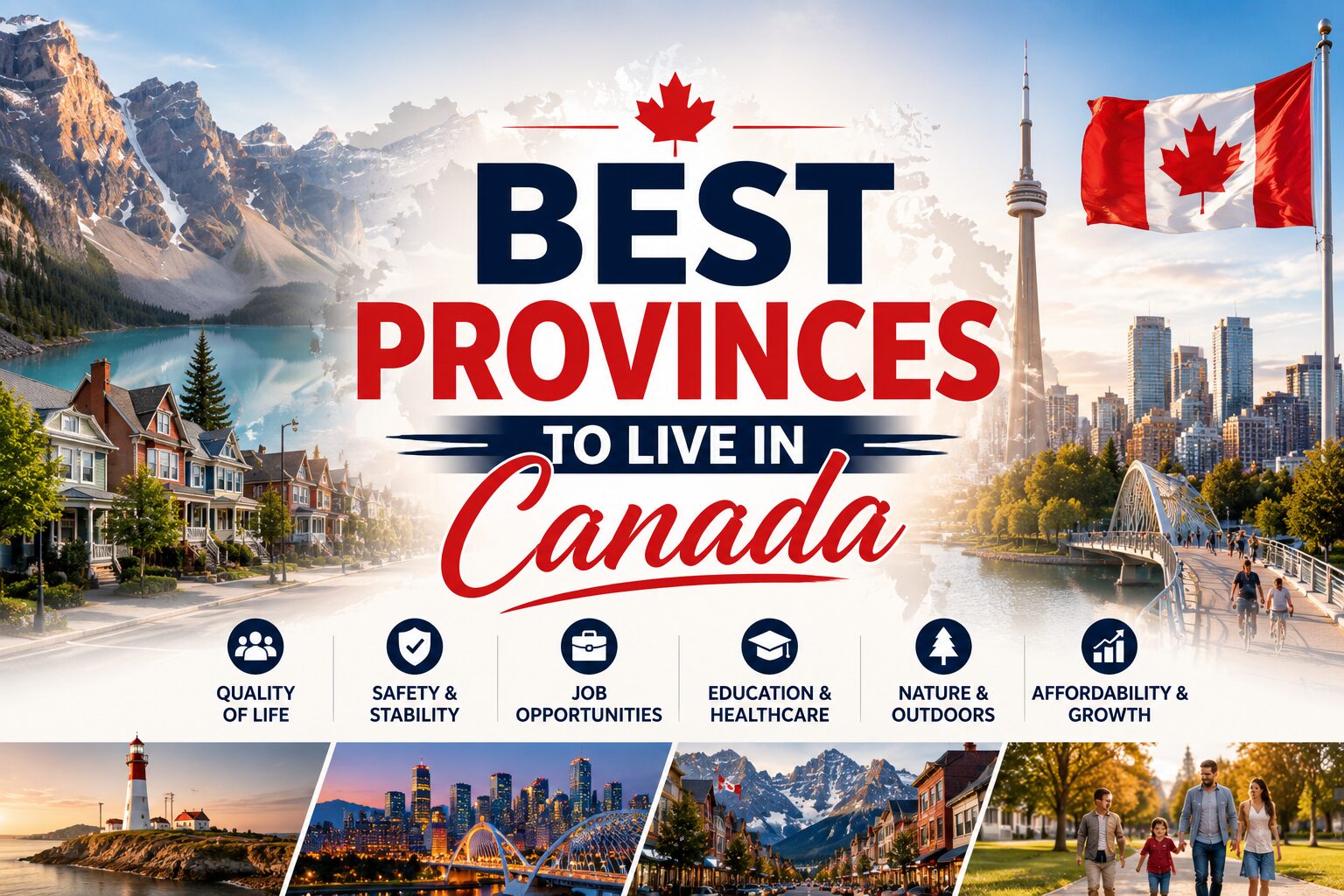
Choosing the right province is one of the most consequential decisions you’ll make in Canada. The best provinces to live in Canada each offer something different — Alberta’s tax advantages and booming job market, British Columbia’s coastal lifestyle, Ontario’s world-class career diversity, and the Maritime provinces’ remarkable affordability and community warmth.
In this 2026 guide we’ve ranked all 10 Canadian provinces across 10 critical factors — housing affordability, employment, healthcare, taxes, safety, education, climate, and quality of life — drawing on the latest data from Statistics Canada, CMHC, and provincial government sources.
Whether you’re a student, professional, new immigrant, growing family, or retiree — this guide will help you find the province that fits your life best.
How We Ranked the Best Provinces to Live in Canada
Our methodology combines the latest publicly available government data with real-world livability factors weighted by what Canadians, newcomers, and migrants consistently cite as most important.
10 Ranking Factors
- 01Cost of Living
- 02Housing Affordability
- 03Employment Opportunities
- 04Average Salaries
- 05Healthcare Quality
- 06Education System
- 07Crime Rates & Safety
- 08Economic Growth
- 09Population Growth
- 10Quality of Life
Factor Weighting
25%
Average home prices, rent burden relative to median household income
22%
Unemployment rate, job growth, average weekly earnings and industry diversity
18%
Wait times, doctor-to-patient ratio, hospital access, per-capita health spending
15%
Crime Severity Index (Statistics Canada), violent crime rate, public safety perception
12%
Provincial income tax, HST/GST/PST, property tax and net take-home pay impact
8%
School performance rankings, university access, post-secondary tuition costs
Data sources: Statistics Canada · CMHC · CREA · Conference Board of Canada · Provincial government reports 2025–2026
Full Province Comparison Table (2026)
Scroll horizontally to see all columns. All figures are 2025–2026 benchmarks.
| Province | Population | Avg Home Price | Unemployment | Sales Tax | Income Tax | Safety | QOL |
|---|---|---|---|---|---|---|---|
|
#1Alberta
|
4.7M | $480K | 5.8% | 5% GST only | Lowest ★★★★★ | 7.2/10 | 9.1/10 |
|
#2British Columbia
|
5.6M | $985K | 6.2% | 5%+7% PST | Moderate ★★★☆☆ | 8.1/10 | 8.8/10 |
|
#3Ontario
|
15.2M | $870K | 6.5% | 13% HST | Moderate ★★★☆☆ | 7.6/10 | 8.5/10 |
|
#4Nova Scotia
|
1.07M | $415K | 7.1% | 15% HST | High ★★☆☆☆ | 8.4/10 | 8.2/10 |
|
#5Saskatchewan
|
1.19M | $320K | 5.4% | 5%+6% PST | Moderate ★★★☆☆ | 7.0/10 | 7.9/10 |
|
#6Manitoba
|
1.45M | $355K | 5.9% | 5%+7% PST | High ★★☆☆☆ | 6.5/10 | 7.6/10 |
|
#7New Brunswick
|
836K | $265K | 7.6% | 15% HST | High ★★☆☆☆ | 8.6/10 | 7.5/10 |
|
#8PEI
|
173K | $340K | 5.1% | 15% HST | High ★★☆☆☆ | 9.2/10 | 7.4/10 |
|
#9Quebec
|
8.9M | $450K | 5.7% | 5%+9.975% QST | Highest ★☆☆☆☆ | 8.0/10 | 7.3/10 |
|
#10Newfoundland
|
534K | $285K | 8.9% | 15% HST | High ★★☆☆☆ | 8.8/10 | 7.0/10 |
Sources: Statistics Canada · CREA · CMHC · Figures are approximate benchmarks for 2025–2026
Top 10 Best Provinces to Live in Canada (2026 Rankings)
Overview
Alberta sits firmly at the top of our 2026 Canada province rankings. It offers the best combination of high salaries, no provincial income tax, relatively affordable housing, and a red-hot job market. The province’s economy has diversified well beyond oil and gas into tech, agriculture, and renewable energy. According to Statistics Canada, Alberta consistently posts Canada’s highest average weekly earnings.
Calgary has become Canada’s fastest-growing major city, drawing young professionals and families priced out of Vancouver and Toronto. Edmonton offers a lower cost of living with strong public services and growing tech and healthcare sectors.
✅ Pros
- →No provincial income tax — keeps thousands more in your pocket annually
- →Lowest sales tax in Canada — 5% GST only, no PST
- →Booming job market across energy, tech, construction, and agri-food
- →World-class Rocky Mountain access for outdoor recreation year-round
- →Housing still comparatively affordable versus BC and Ontario
⚠️ Cons
- →Long, harsh winters — temperatures regularly hit −30°C windchill
- →Economy remains somewhat sensitive to oil price volatility
- →Healthcare under strain in rural areas outside Calgary and Edmonton
🎯 Who Should Move Here?
Young professionals seeking higher take-home pay, tradespeople, engineers, tech workers, and families wanting affordable single-family homes near nature. Excellent for immigrants through the Alberta Advantage Immigration Program (AAIP). For newcomers exploring educational pathways, see Canada’s top scholarships for international students.
9.1 / 10
Overview
British Columbia offers Canada’s mildest winters, spectacular Pacific scenery, a thriving Vancouver tech sector, and one of the world’s most diverse populations. The trade-off is clear — Vancouver housing is among the most expensive in North America. However, cities like Kelowna, Kamloops, and the Fraser Valley offer far more reasonable prices while still delivering BC’s signature lifestyle.
BC is a top destination for immigrants and international students due to established settlement networks and world-class universities including UBC and SFU. The province’s proximity to Asia-Pacific markets creates unique career opportunities unavailable elsewhere in Canada. If you’re considering professional development to compete in BC’s job market, explore the best online courses in Canada for career advancement.
✅ Pros
- →Mildest climate in Canada, especially the Lower Mainland and Vancouver Island
- →World-class tech, film, and green energy job market in Vancouver
- →Exceptional university and college education system
- →Mountains, ocean, and wine country all within a few hours
- →Gateway to Asia-Pacific — strong international business connections
⚠️ Cons
- →Housing affordability among worst in North America in Vancouver
- →High overall cost of living, especially in Metro Vancouver
- →Traffic and urban density challenges throughout the Lower Mainland
🎯 Who Should Move Here?
Tech workers, international students, healthcare professionals, and anyone who values lifestyle, climate, and cultural diversity above all else. BC is a favourite for immigrants from Southeast Asia, South Asia, and China. Also strong for retirees who want mild weather and natural beauty.
8.8 / 10
Overview
Ontario is Canada’s economic engine, home to Toronto — one of the world’s most multicultural cities — and Ottawa, the capital. If you’re chasing career opportunities, Ontario is nearly impossible to beat. The GTA alone accounts for close to 20% of Canada’s GDP, with dominant industries in finance, tech, healthcare, law, and education. According to the Government of Canada, Ontario receives the majority of new immigrants each year.
Housing in Toronto is brutal, but cities like Hamilton, Kingston, Windsor, and Sudbury offer dramatically lower prices while still tapping into Ontario’s strong job network. Toronto remains Canada’s largest city and most powerful economic hub by a wide margin.
✅ Pros
- →Largest job market in Canada by a wide margin
- →Exceptional healthcare infrastructure in urban centres
- →World-class universities — U of T, Waterloo, McMaster, Western
- →Unmatched diversity — over 200 languages spoken in Greater Toronto
- →Best immigration settlement programs and newcomer support networks
⚠️ Cons
- →Toronto real estate remains near the most expensive in North America
- →13% HST increases the cost of almost everything noticeably
- →Toronto traffic ranks among the worst commutes in North America
🎯 Who Should Move Here?
Finance and tech professionals, immigrants with family ties to the GTA, healthcare providers, students, and anyone who prioritizes career advancement over housing affordability. Ontario rewards ambition like no other province in Canada.
8.5 / 10
Overview
Nova Scotia has transformed from Canada’s best-kept secret into a legitimate top-10 relocation destination. Halifax has emerged as a buzzing mid-size city with a vibrant tech sector, excellent universities (Dalhousie, NSCAD), and a food-and-arts scene that punches far above its weight. The province consistently ranks among Canada’s safest — several of Canada’s safest cities in 2026 are found right here.
The main drawback is the 15% HST and higher provincial income tax rates. But when your mortgage is half what you’d pay in Toronto, it often still works out ahead. Nova Scotia has been actively courting newcomers through its Provincial Nominee Program and the Atlantic Immigration Program.
✅ Pros
- →Among the most affordable real estate of any major Canadian city
- →Stunning coastal landscapes, seafood culture, and genuine Maritime charm
- →Growing tech and healthcare job market anchored by Halifax
- →Tight-knit, welcoming communities ideal for families and retirees
- →High safety scores — low violent crime rates province-wide
⚠️ Cons
- →15% HST is among the highest sales taxes in Canada
- →Job market outside Halifax is limited in some specialized sectors
- →Smaller population limits big-city cultural diversity
🎯 Who Should Move Here?
Remote workers escaping Toronto or Vancouver costs, retirees, young families seeking safety and quality of life, and immigrants looking for a welcoming mid-size city with reasonable living costs and fast PR pathways through the Atlantic Immigration Program.
8.2 / 10
Overview
Saskatchewan is the sleeping giant of Canada’s affordable province list. In 2026, it offers some of the lowest home prices in the country, a strong agricultural and mining economy, and one of the lowest unemployment rates outside Alberta. Saskatoon has evolved into a dynamic city with a young population, a thriving arts scene, and growing tech and health research sectors centred around the University of Saskatchewan. CMHC data shows housing affordability stress affects fewer than 20% of Regina and Saskatoon households — versus over 40% in Toronto.
The province’s one shortcoming has been a higher crime rate in certain urban areas, though government investment in community safety is showing measurable improvement. For families wanting to stretch their dollars, Saskatchewan remains one of the best value propositions in all of Canada.
✅ Pros
- →Among the most affordable housing markets in Canada
- →Second-lowest unemployment rate in the country after Alberta
- →Strong demand for skilled trades, agriculture, and healthcare workers
- →Low combined sales tax — 5% GST + 6% PST only
- →Genuine small-city feel with growing big-city ambition in Saskatoon
⚠️ Cons
- →Elevated crime rates in specific Regina and Saskatoon inner-city areas
- →Very harsh winters — second only to Manitoba in cold severity
- →Limited public transit infrastructure outside main city cores
🎯 Who Should Move Here?
Tradespeople, agricultural workers, healthcare professionals, and budget-conscious families who want to own a detached home without crushing debt. Also excellent for immigrants through the Saskatchewan Immigrant Nominee Program (SINP) — one of Canada’s most active provincial streams.
7.9 / 10
Overview
Manitoba sits at the geographic heart of Canada, and the province punches well above its weight on immigrant settlement and multicultural community building. It has been a top receiver of Filipino, Ukrainian, South Asian, and African newcomers for over two decades — creating warm, established support networks that make the transition to Canadian life significantly easier. Housing is genuinely affordable, and a detached home in Winnipeg’s desirable neighbourhoods costs a fraction of comparable homes in Toronto or Calgary.
The Manitoba Provincial Nominee Program (MPNP) is one of Canada’s most active. The key drawback is a higher income tax rate and elevated crime in certain Winnipeg neighbourhoods, which has been an ongoing public safety challenge the province continues to address through targeted investment.
✅ Pros
- →Affordable housing — large detached homes well under $400K
- →Canada’s most established Filipino diaspora community
- →Active MPNP with multiple immigration streams
- →Strong healthcare workforce employment opportunities
- →University of Manitoba is a respected research institution
⚠️ Cons
- →Winnipeg has elevated crime in specific inner-city areas
- →Among the harshest winters in Canada — regularly −35°C windchill
- →Higher provincial income tax compared to Alberta and Saskatchewan
🎯 Who Should Move Here?
Immigrants with existing community ties (especially Filipino, Ukrainian, and South Asian backgrounds), healthcare workers, and families seeking affordable homeownership. Also appealing to anyone who values deep community roots over big-city pace.
7.6 / 10
Overview
New Brunswick holds the remarkable distinction of having the lowest average home prices in all of Canada at roughly $265,000 — less than a third of what you’d pay in Toronto. The province is officially bilingual, making it uniquely accessible to both English and French-speaking newcomers. Moncton has transformed from a railway town into a buzzing hub of retail, logistics, tech support, and healthcare employment, and is the fastest-growing city in Atlantic Canada. When you look at how these home prices compare to Canada’s most expensive cities, the contrast is extraordinary.
The province has leaned heavily into immigration to address demographic challenges, and the New Brunswick Provincial Nominee Program (NBPNP) is one of the most welcoming in Atlantic Canada. The 15% HST and slightly higher unemployment are the main trade-offs against its incredible affordability advantage.
✅ Pros
- →Lowest average home prices in the entire country
- →Officially bilingual province — English and French both widely used
- →Very low crime rates and peaceful, welcoming communities
- →Active NBPNP with strong newcomer settlement support
- →Beautiful forests, coastline, and rivers — stunning natural environment
⚠️ Cons
- →15% HST is among Canada’s highest sales taxes
- →Unemployment at 7.6% — above the national average
- →Limited job market for specialized professionals outside Moncton
🎯 Who Should Move Here?
Remote workers escaping big-city costs, retirees on fixed incomes, bilingual professionals, and young families priced out of major cities. New Brunswick is the best bang-for-buck province in Canada for anyone who can work flexibly.
7.5 / 10
Overview
Prince Edward Island is Canada’s smallest province — and arguably its most charming. With a Crime Severity Index consistently at the very bottom of all Canadian provinces, PEI is the safest place to raise a family in the country. The island has experienced the fastest population growth rate of any province in recent years, driven largely by immigration through the PEI Provincial Nominee Program and a surge in international students at UPEI.
Charlottetown is walkable, friendly, and culturally active for its size. Tourism, agriculture, and a growing seafood export sector anchor the economy. The one real challenge is the limited job market outside government, hospitality, and agriculture — professionals in specialized fields may find opportunities harder to come by than in larger provinces.
✅ Pros
- →Safest province in Canada by Crime Severity Index
- →Remarkably tight-knit, warm, and welcoming community culture
- →Red sand beaches, rolling farmland — stunning natural beauty
- →Active PNP — especially for international students and workers
- →Moderate housing costs — far below Ontario and BC
⚠️ Cons
- →Limited job market for professionals outside government and hospitality
- →15% HST — one of the highest sales tax rates in Canada
- →Island isolation — Confederation Bridge or flying are the only options
🎯 Who Should Move Here?
Retirees, remote workers, families prioritizing safety and nature over career pace, and international students using UPEI as a pathway to Canadian permanent residency. PEI is a slow, beautiful, deeply human place to build a life.
7.4 / 10
Overview
Quebec is Canada’s most culturally distinct province and one of the most complex relocation decisions. On one hand it delivers extraordinary benefits — deeply subsidized childcare at under $10/day, the lowest university tuition in Canada, relatively affordable housing versus Ontario and BC, and a world-class food, arts, and nightlife scene in Montreal. On the other hand, it carries Canada’s highest provincial income tax burden and effectively requires French proficiency for most professional work and daily life.
Montreal’s tech sector has become a global AI research hub with companies like Mila and major offices of Google DeepMind and Microsoft Research. For French-speaking immigrants, Quebec offers the Quebec Skilled Worker Program and the Programme de l’expérience québécoise (PEQ) — targeted pathways supported by IRCC frameworks.
✅ Pros
- →Subsidized childcare under $10/day — a genuine game-changer for families
- →Lowest university tuition in Canada for Quebec residents
- →Montreal is a world-class city at roughly half the cost of Toronto
- →Booming AI, tech, and video game industries in Montreal
- →Rich French culture, cuisine, festivals, and vibrant arts scene
⚠️ Cons
- →Highest provincial income tax in Canada — significantly reduces take-home pay
- →French language is essential — a real barrier for English-only speakers
- →Quebec’s separate immigration selection adds complexity to the process
🎯 Who Should Move Here?
French-speaking immigrants, AI and tech professionals, families who want subsidized childcare, artists and creatives, and anyone who values culture and lifestyle over maximum take-home pay. Quebec rewards those who embrace it — but it demands commitment to the French language.
7.3 / 10
Overview
Newfoundland and Labrador holds a special place in the hearts of Canadians. Its people are legendarily warm and generous, its landscape is jaw-dropping — fjords, icebergs, whales, and Gros Morne National Park — and St. John’s is one of the most colourful and character-filled cities in the country. The province’s biggest challenge is economic: with Canada’s highest unemployment rate at 8.9% and an economy tied heavily to oil and fisheries, it’s a difficult province for career-driven individuals without existing industry ties.
That said, if you can work remotely or in resource industries, NL offers extraordinary value — cheap homes, clean air, safe communities, and a pace of life that urban Canadians increasingly crave. Safety scores are excellent, ranking second only to PEI. The provincial government is actively investing in green energy and offshore wind to diversify beyond oil dependence.
✅ Pros
- →Among the cheapest real estate in all of Canada
- →Second safest province in Canada — very low violent crime
- →Unmatched natural scenery — fjords, icebergs, whales, Gros Morne
- →The warmest, most hospitable people you’ll find anywhere in Canada
- →Completely unique culture, music, humour, and culinary traditions
⚠️ Cons
- →Canada’s highest unemployment rate at 8.9%
- →Geographic isolation — flying or ferry are the only options
- →Economy tied to volatile oil and fisheries sectors
🎯 Who Should Move Here?
Remote workers wanting maximum quality of life at minimum cost, retirees seeking safety and peace, those in oil, offshore energy, fishing, or tourism, and anyone who has ever visited the island and never quite recovered from how special it felt.
7.0 / 10
Best Province in Canada for Jobs
Employment drives migration. Canada’s job landscape in 2026 is deeply unequal across provinces. Here’s how the top performers break down. If you’re looking to upskill for a competitive market, explore the best online courses in Canada for career advancement.
🔥 Alberta — Best Overall for Employment
Alberta’s 5.8% unemployment rate and Canada’s highest average weekly earnings make it the clear jobs leader. Energy, construction, tech, and agri-food are all expanding. Calgary’s startup scene now ranks in Canada’s top three cities for venture capital. The province actively recruits skilled workers through the Alberta Advantage Immigration Program (AAIP).
💻 Ontario — Best for Finance, Tech & Healthcare
Toronto’s MaRS Discovery District is the largest innovation hub in North America after Silicon Valley. Ontario dominates financial services, insurance, legal, and healthcare employment. While unemployment is slightly higher at 6.5%, the sheer volume of openings means more total opportunities than anywhere else in Canada. Toronto remains Canada’s largest and most powerful economic city.
🌐 British Columbia — Best for Tech & Pacific Trade
Vancouver is Canada’s Pacific gateway and a magnet for tech companies — from Amazon and Microsoft Canada offices to a thriving local startup scene. Film and TV production, green energy, tourism, and real estate drive significant employment. BC’s proximity to US and Asian markets creates trade-based career opportunities unavailable elsewhere in Canada.
🌾 Saskatchewan — Best for Trades & Agriculture
Saskatchewan’s 5.4% unemployment rate is second only to Alberta, with consistently strong demand for skilled tradespeople, agricultural scientists, miners, and healthcare workers. The province’s potash industry is globally significant, and Saskatoon’s growing biotech and health science sectors are creating new white-collar opportunities.
Cheapest Province to Live in Canada
Affordability is the number one question we receive from newcomers and families considering a move. These provinces offer the most value for money in 2026, measured by housing, food, transportation, and overall daily cost of living.
Best Province in Canada for Families
For families, the decision is rarely just about jobs or housing — it’s about schools, safety, healthcare, outdoor space, and community. Here’s how the key factors break down across provinces.
🎓 Schools & Education
Ontario leads in post-secondary access with the highest concentration of top-ranked universities. BC and Alberta consistently top public school performance rankings. Quebec is uniquely attractive for French-speaking families — under $10/day licensed daycare and subsidized CÉGEP tuition are transformative financial advantages. According to Statistics Canada, educational attainment is highest in Ontario and BC.
🏥 Healthcare for Families
Ontario and British Columbia have the most developed pediatric and specialist networks. PEI scores highest for healthcare satisfaction per capita due to personalized, community-scale service. Rural provinces like Saskatchewan and Newfoundland face doctor shortages that can significantly impact family access to specialist care. Visit Canada.ca for provincial health system comparisons.
🛡️ Safety for Families
PEI ranks as Canada’s safest province by Crime Severity Index. Nova Scotia, Newfoundland, and New Brunswick round out the top four safest. Alberta and BC have higher crime in specific urban neighbourhoods but excellent safety scores in suburban and smaller communities. See our full guide to Canada’s safest cities in 2026.
🏠 Housing Affordability for Families
CMHC data confirms that housing cost stress — spending over 30% of income on shelter — affects over 40% of Toronto and Vancouver families but fewer than 20% in Saskatoon and Regina. A family needing a 3-bedroom detached home will find the best value in Saskatchewan, Manitoba, New Brunswick, and Nova Scotia.
🏆 Best Overall for Families: Alberta
Alberta wins for families — high salaries, no provincial income tax, comparatively affordable housing, strong school rankings, and easy access to outdoor recreation. For budget-first families, New Brunswick or Saskatchewan are the best alternatives where homeownership is accessible on modest incomes.
Best Province for New Immigrants
Canada welcomed over 400,000 new permanent residents in 2024. Each province offers distinct immigration streams, settlement infrastructure, community networks, and cost advantages. Here’s how the leading options compare for newcomers.
Ontario — Largest Settlement Network
Ontario receives the majority of Canada’s new immigrants. Toronto alone speaks over 200 languages. Settlement agencies, language training, credential recognition, and professional networks are the most developed in the country. The Ontario Immigrant Nominee Program (OINP) is one of Canada’s largest. Per IRCC data, Ontario consistently leads in Express Entry and family class arrivals.
Alberta — Highest Take-Home Pay
No provincial income tax, high wages, and a thriving immigrant community in Calgary and Edmonton make Alberta the best province for earning and saving as a newcomer. The AAIP actively recruits engineers, healthcare workers, tradespeople, and tech professionals. Calgary’s South Asian, Filipino, and African communities provide strong cultural support networks.
British Columbia — Best for Asian Communities
Metro Vancouver has the largest Chinese, South Korean, and Southeast Asian communities in Canada. Burnaby, Richmond, and Surrey are among Canada’s most multicultural cities. BC’s PNP targets tech workers, healthcare professionals, and international graduates from BC universities. The trade-off is Vancouver’s extreme housing cost.
Atlantic Canada — Easiest Settlement
The Atlantic Immigration Program (AIP) targets immigrants specifically for New Brunswick, Nova Scotia, PEI, and Newfoundland, offering some of Canada’s fastest PR timelines, low housing costs, and genuinely warm welcomes. Moncton’s immigrant population has more than tripled in the past decade. For newcomers prioritizing a smooth transition over big-city ambition, Atlantic Canada is hard to beat.
Important: Immigration pathways change frequently. Always verify current program requirements directly through IRCC’s official website before making any decisions.
Best Province for Retirees in Canada
Retirement priorities shift toward healthcare access, safety, cost of living, climate, and a slower pace of life. Here’s how provinces compare on what matters most in retirement.
🏥 Healthcare Access
Ontario and BC have the most developed specialist and elder care networks. PEI offers the highest healthcare satisfaction per capita. Rural provinces face doctor shortages that can mean long specialist wait times — a critical factor for retirees with ongoing health needs. Per Health Canada, all provinces provide universal public insurance but speed and quality of service varies significantly.
💰 Property Costs on Fixed Income
New Brunswick, Newfoundland, and Saskatchewan offer the most stretch for fixed incomes. A retiree selling a Toronto home and relocating to Fredericton could buy outright and invest the difference. CMHC confirms Atlantic home prices are 60–70% lower than Ontario and BC benchmarks.
🌤️ Climate for Retirees
British Columbia wins for mild winters — particularly Vancouver Island and the Okanagan Valley. Victoria has one of the highest per-capita retiree populations in Canada for exactly this reason. Prairie provinces have glorious summers but brutal winters that can be challenging for older adults. Nova Scotia offers moderate four-season Atlantic climate.
🌿 Community & Lifestyle
Prince Edward Island consistently scores highest for community warmth and personal happiness among retirees. Nova Scotia’s coastal towns are extremely popular for retirement living. Both provinces offer a deeply human, unhurried pace of life increasingly rare in modern Canada.
🏆 Retirement Verdict by Priority
Best climate: British Columbia (Victoria, Kelowna)
Most affordable: New Brunswick or Saskatchewan
Best community & safety: Prince Edward Island
Best healthcare access: Ontario (Toronto, Ottawa)
Best overall retirement package: Nova Scotia
Safest Provinces in Canada
The Crime Severity Index (CSI), published annually by Statistics Canada, measures both the volume and severity of police-reported crime. Lower CSI = safer province.
CSI: 42 · 9.2/10
Lowest violent crime rate of any province. Exceptionally safe for families and retirees.
CSI: 52 · 8.8/10
Remote communities contribute to low crime. St. John’s is one of Canada’s safest mid-size cities.
CSI: 58 · 8.6/10
Small cities and rural communities enjoy low crime consistently. Moncton and Fredericton are safe.
CSI: 64 · 8.4/10
Halifax is exceptionally safe for a city its size. See the full Canada safest cities ranking.
CSI: 70 · 7.6/10
Suburban Ontario is very safe. Toronto’s inner city elevates the provincial average but remains manageable.
CSI: 95–110+
Highest crime rates in Canada — driven by elevated rates in Winnipeg and Saskatoon inner-city areas. Suburban and rural communities are significantly safer.
Which Province Has the Lowest Taxes?
Tax burden varies dramatically across provinces. The difference in take-home pay between Alberta and Quebec on the same salary can amount to $8,000–$12,000 per year. Here’s a plain-English breakdown of the three main tax categories.
Income Tax
Sales Tax
Rating
10% flat
5% GST only
★★★★★
10.5%–14.5%
5%+6% PST
★★★★☆
5.06%–20.5%
5%+7% PST
★★★☆☆
5.05%–13.16%
13% HST
★★★☆☆
8.79%–21%
15% HST
★★☆☆☆
14%–25.75%
~15% combined
★☆☆☆☆
Key takeaway: A person earning $120,000 in Alberta keeps approximately $8,000–$12,000 more per year after tax compared to the same salary in Quebec. That difference compounds significantly over a career. However, Quebec’s subsidized services (childcare, education) offset some of this for families with young children.
Frequently Asked Questions
The most common questions about the best provinces to live in Canada — answered plainly.
What are the Best Provinces to Live in Canada?
Based on our 2026 analysis, the top five are Alberta (#1), British Columbia (#2), Ontario (#3), Nova Scotia (#4), and Saskatchewan (#5). Alberta leads due to its unbeatable combination of no provincial income tax, high wages, and growing affordability. The right province for you depends on your personal priorities.
Which province has the best quality of life in Canada?
Alberta scores highest on our overall QOL index at 9.1/10, followed by BC (8.8/10) and Ontario (8.5/10). However, BC arguably offers the best pure lifestyle experience — mild climate, stunning nature, diverse culture — if housing cost isn’t your primary concern. PEI scores highest specifically for community well-being, safety, and personal happiness.
What is the cheapest province to live in Canada?
New Brunswick is the cheapest province by average home price (~$265,000), followed by Newfoundland & Labrador (~$285,000) and Saskatchewan (~$320,000). For overall daily cost of living, Saskatchewan and Manitoba also rank among the most affordable thanks to lower food, transportation, and utility costs.
Which province has the most jobs?
Ontario has the highest absolute number of job openings due to its scale. Alberta leads in employment rate, wages, and job growth relative to population — making it the best province for landing a well-paying job quickly. BC leads in tech and Pacific trade roles, while Saskatchewan leads for agriculture,